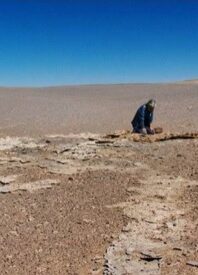
Astronomer George Galaz asks “Where do we come from, it’s a key question,” to Patricio Guzman. It’s one of the many rhetorical yet real questions to any field of study, Galaz doing so in the Atacama. The Atacama desert is also the location of two of the most painful moments in Chile’s violent recent history. During the turn of the twentieth century, the country mined saltpeter there, exploiting Indigenous workers, burying them. The same goes for the political prisoners of recent times, their bones mixing with the desert, missing their families.
One can’t help but feel the beauty that viewers may see in Guzman’s Nostalgia for the Light, even after knowing the context behind such images. He shows spoons that still make noise if the occasional gust of wind goes through a shack. Shacks like those can still stand still in the desert. The sights and sounds in this film capture the remnants of life, Life that were and still are in the desert for millennia. One can still find bones of aquatic life on the Atacama desert. It was, after all, under sea level 200 million years ago. Those fossils mingle with more recent bones of people who still have families today, still there if those survivors look.
Guzman rightfully paints the desert as a place of death and pain, but thankfully, his film shows hope that’s needed. That’s probably why the documentary has its astronomy section, a study, like most studies, that lives one’s curiosity. Through his narration in Nostalgia for the Light, the viewers learn about many countries collaborating in Chile. Curiosity, as one of the interview subjects implies, may uncover pain, but all of us benefit from learning all of history. We look into the past and the future as astronomers watch light that’s coming to us millions of years from its source.
Nostalgia for the Light is a film that juggles its many stunning moments with ones snapping viewers back to reality. The film has its share of interviews, including that of astronomers who survived Pinochet’s concentration camps. That interviewee reminds us that Chile doesn’t talk about recent history, about what happened in the saltpeter industry. The same goes for the atrocities that he endured and survived, him being luckier than many of his peers who didn’t. Most people are curious but as he says, ‘It’s up to the military to provide this information’ but that institution won’t.
The Atacama desert was a burial ground for thousands of years, Nostalgia for the Light telling of those stories. Again, one of Guzman’s narration scenes have him showing pebbles, discussing Indigenous burial practices. Different people have different ways of respecting the dead depending on one’s affinity for those wandering souls. Pinochet’s dictatorship is generations ago but their survivors are still gathering remains, making them whole. Guzman tells as many stories has he can with sensitivity in his film, a quality viewers will miss much dearly.
Nostalgia for the Light is available to stream for free on OVID until September 25.
- Rated: AL
- Genre: Documentary
- Directed by: Patricio Guzmán
- Produced by: Meike Martens, Renate Sachse
- Studio: Atacama Productions, Blinker Filmproduktion, Cronomedia, WDR