
Each year, Haymitch Abernathy (Joseph Zada) recognizes his birthday on Reaping Day. Celebrations are hard to come by, even for the kids in District 12 that aren’t chosen for the Hunger Games. This particular year, to mark 50 years of the games, double the number of tributes will be selected. Double the death for districts. Double the ‘fun’ for the Capitol in this second Quarter Quell.
Presumably, if you’re watching the newest instalment in the Hunger Games franchise, Sunrise on the Reaping, you know the general premise. But just in case – in a dystopian world called Panem, the dictatorial government, led currently by President Snow each year holds an event where children aged 12-18, typically two from each District, fight to the death in increasingly complicated and deadly arenas. This was contrived after the so called Dark Days where there was a bloody rebellion, in order to keep the Districts in check and the Capitol’s power unchallenged.
In the original films, starring Jennifer Lawrence, which were released from 2012 to 2015, we see the resistance grow until the second rebellion takes place. And Haymitch is a big part of that, the beloved character, a drunkenly but likeable curmudgeon whom Woody Harrelson plays in the original films. But, as of now, he will have to wait another quarter century before he can see the oppression of the Capitol abolished. And he will have to get out of these Hunger Games to reach his destiny.
Of course, he doesn’t know all of this is in his future. All young Haymitch cares about is his mother, his brother, Sid, and his girl Lenore Dove (Whitney Peak), whom he loves like all-fire. He helps Hattie make moonshine in the woods and brings Lenore Dove’s geese handfuls of corn. It’s a simple life if you stay on the right side of the Peacekeepers. Until this Reaping Day. At the ceremony, Drusilla Sickle (an almost unrecognizable Glenn Close,) embodying the excess of the Capitol in a gaudy yellow outfit, doesn’t pick Haymitch’s name. But, when an altercation leaves Lenore Dove at risk, he steps in, and becomes an accidental tribute.
As four tributes this year are chosen, Haymitch rides the train to the Capitol with Maysilee Donner (Mckenna Grace), Wyatt Callow (Ben Wang) and Louella McCoy (Molly McCann). Before the games start, they must submit to makeovers, training and interviews. But, after an incident at the opening ceremonies puts Haymitch directly at odds with the evil President Snow (Ralph Fiennes), he knows he is likely marked for death. Knowing he’s not going to see home again, he decides to make his mark on the games in a different way, joining forces with a former winner Beetee (Kelvin Harrison Jr.) and his son to try and break the arena in which they compete. It is just a machine after all. Haymitch doesn’t want the Capitol using his blood to paint their posters, he wants to create one all his own, that defies everything the oppressors stand for.
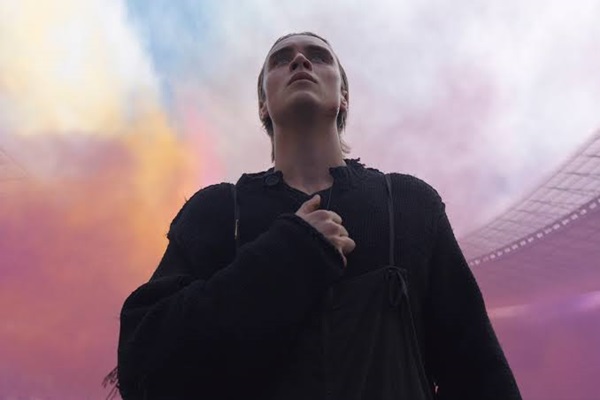
Cr. Courtesy of Cineplex © 2026
Now, as mentioned, Haymitch is in the first films, so we know he survives. Director Francis Lawrence, returning to helm his 5th Hunger Games film (the first was directed by Gary Ross) loses that tension building detail. But, fans of the novel will tell you that this entry to the Games canon is about so much more than that. The film is fairly faithful to the book, though readers may miss a few omissions. But at almost two hours and forty minutes, cuts always have to happen, and the film’s pacing is probably the better for them. Some of the deaths are also a lot less gory than described in Suzanne Collin’s novel, but that’s to be expected with a PG-13 rating.
Lawrence is blessed to have relative newcomer Joseph Zada as young Haymitch. He never does a Harrelson impression, but the cadence of his voice every so often makes it more than believable that he grows into that man. The supporting cast couldn’t be more star-laden with Jesse Plemons as Plutarch Heavensbee (originally played by Philip Seymour Hoffman). There are also Kieran Culkin as a young Caesar Flickerman (originally Stanley Tucci) and Elle Fanning as Effie Trinket (originally Elizabeth Banks). Add on the aforementioned Close, Harrison Jr., Fiennes as well as Maya Hawke and Billy Porter, and this could be a crowded stage. Yet, each commands their roles, even small parts, without overshadowing the others, or the narrative’s message. Ultimately, this is truly Zada’s story to tell and he shoulders that responsibility with confidence.
As Haymitch rises into a bright, colourful arena (reminiscent of Midsommar’s vivid palette) you soon find out it’s as deadly as it is beautiful. But, to end up as the broken man we discover in the future, Haymitch must endure a staggering amount of trauma. And it runs much deeper than the Games themselves. There’s more at stake for him than just survival. Sunrise on the Reaping as a film mirrors the book’s quiet devastation. Just as in the novel, Edgar Allan Poe’s famous poem ‘The Raven’ makes an appearance with its grief-stricken narrator capturing Haymitch’s own emotional state. In the end, the movie largely hits all its intended emotional marks, helped by Zada’s performance and the score from James Newton Howard, who maintains and expands the musical themes he has introduced to each film in the franchise.
It seems strange that a film franchise nearing 15 years old is still just as relevant in its messaging as the day it was first released. Yet, here we are. Its tag line – Break the machine, change the Games – strikes a contemporary chord. In a time when citizens are rising up to voice their concerns about AI and data centres, government and politics, Sunrise on the Reaping, like the first series, feels extraordinarily pertinent. It’s also probably the best of the franchise since 2013’s Catching Fire. “I like my pretty with a purpose,” Lenore Dove remarks, and this engaging, visually compelling adaptation delivers exactly that.
- Rated: PG-13
- Genre: Action, Adventure, Science Fiction
- Release Date: 11/20/2026
- Directed by: Francis Lawrence
- Starring: Elle Fanning, Jesse Plemons, Joseph Zada, Kelvin Harrison Jr, Kieran Culkin, Ralph Fiennes, Whitney Peak
- Produced by: Brad Simpson, Francis Lawrence, Nina Jacobson
- Written by: Billy Ray, Michael Lesslie
- Studio: about:blank, Color Force, Lionsgate, Studio Babelsberg