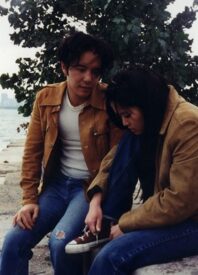
Pictures are somewhat important to Strawberry Fields‘ feisty antiheroine Irene (Suzy Nakamura) and her boyfriend Luke (James Sie). While hanging out in his place, there are pictures of Luke’s parents, a rarity in Irene’s crumbling household. The few pictures that her family has are remnants of the ones her family kept after Japanese American internment. Because of these pictures, some she burnt herself, she and Luke go on a road trip to Arizona.
History is palimpsest, we in the 2020s watch Strawberry Fields a 90s film looking at two time periods. One of those time periods is Irene’s – the early 70s, when counterculture clashes with Asian assimilative normalcy. The film captures that essence through sound design, muffled noises while Irene is high on marijuana during house parties. And I hope I express this properly, but it’s nice watching a film that shows Asian diasporic youth.
Youth is important to Strawberry Fields, as it shows Asians being present in America for at least generations, and even if this film focuses on Irene, a key relationship here is with her mother. That mother, Alice (Marilyn Tokuda), and her fight, Irene’s pyromania, a big subject of those escalating and tense arguments. Eventually, their relationship exists through phone calls, Irene uncovering a past that Irene does not want to talk about.
There’s a lot of talking happening in Strawberry Fields, attempting to ground itself from its quasi-psychedelic style. It eventually sticks the landing by becoming a film where Irene wears two hats as detective and historian. But for a film clocking in at 86 minutes, it takes a while to get its pieces together. Its style, as well as the ghostly presence of a girl, Terri, may understandably confuse some viewers. Cultures clash in Strawberry Fields in style, an imperfect yet interesting mix.
- Rated: Unrated
- Genre: Drama
- Directed by: Rea Tajiri
- Starring: James Sie, Marilyn Tokuda, Reiko Mathieu, Suzy Nakamura
- Written by: Kerri Sakamoto