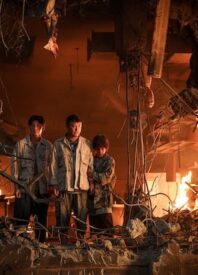
Once Upon a Time in the Middle East shows that everyone needs a little push or money, like Xu Fu (Shen Teng) a Chinese chef living in an unnamed MENA country during a war. His boss Zayd (Sherif Sabry) convinces him to stay, and he negotiates a big raise and to become a restaurant’s co-owner. Co owning the restaurant means serving Chinese-American jarheads like Tony (Aarif Rahman). Zayd promises safety for Xu Fu, something that he can’t guarantee to his family and Xu Fu. American soldiers capture the latter, alongside restaurant manager Ma Junsheng (Jiang Qiming) and apprentice Seif (Omar Sherif). Eventually, that American prison falls in the hands of terrorists, one of them being Zayd himself.
This is a movie that tells its viewers things that it probably already knows – that war is hell, that within both sides of any conflict are people with families, people who work for better lives. Most of the movie gives us Xu Fu’s perspective, showing his justifications, mostly good, for staying back. There are at least scenes here showing his high resolution Skype calls with his Mother (Wei Qing). But even if Zayd is fifth billing in this movie, it has that scene with his family. Those scenes in Once show characters yearning for normalcy even in war when life takes things away.
Aside from showing wartime volatility, Once Upon a Time in the Middle East is good at showing group dynamics and survival. Of course, Xu Fu and Ma are going to be close friends living in a different country. But as the movie progresses it shows them having to adapt to whatever situation they’re in. It helps that both characters have grit, moving up from being prisoners to being prison kitchen staff. It would be easy to chalk this up as ‘Chinese excellence’ but Seif adapts similar qualities too. All three can talk back to American soldiers as ‘friends’, showing that Chinese-ness and cosmopolitanism are complementary.
The scenes in Once Upon a Time in the Middle East show how people from different backgrounds can be friends, to an extent. As the three get comfortable in one situation, life and war shows them what else can happen. For example a Christmas terrorist attack. Again, terrorists take over the prison. The movie is careful at saying country names but is ok with calling some Ba’athists. The movie’s first half shows the evils of American imperialism, complementing the second half showing the evils of terrorism. In a way, it shows Xu Fu and Ma as negotiators, survivalists. They embody a Chinese ethos of being a wise, impartial third party. I may not fully agree with the movie positing these characters and thus China’s ‘objectivity’, but still, I like its audaciousness.
Once Upon a Time in the Middle East is available to watch in select North American theatres.
- Rated: M18
- Genre: Drama, War
- Release Date: 10/9/2026
- Directed by: Wen Muye
- Starring: Aarif Rahman, Jiang Qiming, Omar Sherif, Shen Teng, Sherif Sabry
- Written by: Lang Qunli, Wei Zhong, Wen Muye
- Studio: Alibaba Pictures Group, Bad Monkey, China Film Group Corporation