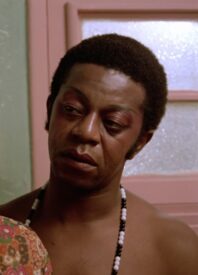
Bereco (Stepan Nercessian) gives his girlfriend Isa Gonzalez (Odete Lara) words of assurance – “My good life is ahead of me”. Of course, she falls for this hook, line, and sinker, not knowing where that supposed good life is coming from. That ticket comes from Raihna Diaba (Milton Gonçalves), the antihero of The Devil Queen. Triple threat Antonio Carlos da Fontoura gives Raihna Diaba a foothold in establishments like The Beloved Women’s Milk Nightclub. There, their henchmen sell drugs like cannabis. Bereco, sadly, doesn’t anticipate Raihna Diaba’s temperament, the latter liking to torture people who dare cross their unmarked territory. As these things go, he betrays her, and doing so has consequences for himself and the woman he dearly loves.
Trixie Mattel said that “drag queens are thieves and liars” in a film depicting what I’ll call a governing “drag queenpin”. I probably wrote about how I’m old enough to remember queer audiences sensitive to negative depictions, which, we’re past that. “Be gay, do crime” is now the current prevailing ethos, and yes, the film is clear about depicting violent criminal activity. Its depictions of queerness, though, is interesting, because of its minimal character design – contemporaneous, typical 70s costumes. There’s that and then Raihna Diaba wears some pastel eye shadow and that’s it, seemingly tame compared to now. The same goes with The Devil Queen‘s images, although Goncalves’ voice work delivers in enforcing Raihna Diaba’s power.
Power is necessary in The Devil Queen, a world of drag queens, sex workers, damsels, and shadowy figures. The city where all this crime takes place is its own character, a dangerous playground for Bereco and his fellow henchmen. Raihna Diaba is the film’s selling point, but they probably have the same amount of time in depicting confident Bereco. He’s an atypical every man of sorts, oblivious, thinking that he can handle the transition from pimping to drug dealing. This transition requires him to walk around the city and its fading pastel walls, where criminals make and break it. The film also gives him an arc as he eventually gets close to Catitu (Nelson Xavier), who wants to betray Raihna.
The Devil Queen is a good showcase of opposites, Raihna Diaba’s flamboyant, nuanced performance and Bereco playing it straight. I also like how the film never pairs them romantically, not that there’s anything with a plot line like that. Raihna’s too busy being paranoid for the film to give them romantic interests, instead depicting rage and queerness together. Aside from these two actors and characters, the film also makes good use of Odeta Lara, de Fontoura’s former wife. As Isa, the film starts her out as a female character who tells her boyfriend not to be brave because brave means dumb. But she eventually ingratiates herself into Bereco’s world as a nightclub singer in a film that makes danger look fun.
Kino Lorber is giving The Devil Queen a roadhouse release, coming to the Revue cinema in Toronto on June 8-9. Afterwards, it comes to Los Angeles, New York City, and hopefully, other major cities in North America.
- Rated: 18
- Genre: crime, Drama
- Directed by: Antonio Carlos da Fontoura
- Starring: Lutero Luiz, Milton Gonçalves, Nelson Xavier, Odete Lara, Stepan Nercessian, Wilson Grey, Yara Cortes
- Produced by: Antonio Carlos da Fontoura, Paulo Porto, Roberto Farias
- Written by: Antonio Carlos da Fontoura
- Studio: Canto Claro Produções Artística, Lanterna Magica, Produções Cinematográficas R.F. Farias, Ventania Filmes