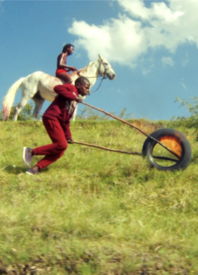
Director Lemohang Jeremiah Mosese narrates through most of Ancestral Visions of the Future. But sometimes, he stops, an attempt to let these images speak for themselves, as any director would. Through these images we see Lesotho’s countryside rivers where boys swim, or where mothers do their laundry. Where boys and men till a fertile soil. Mosese depicts any landscape with saturated colours, plants rich and green. Most of the film shows Lesotho’s cities, where sunlight creates shadows or old men or women sitting alone. These cities are both mundane and haunting, where natural light turns to red, where people become ghosts.
One can’t help but acknowledge that this is a personal work for Mosese as he tells stories through narration. He opens Ancestral with intertitles sincerely calling it “ode to cinema, an eternal nod to my mother” and it is. The images tell parallel stories, not quite the one about his family but younger versions, new carbon copies. Sometimes, it shows women, but the first act shows a little boy and his sinewy grandfather. In a way, this speaks to the struggles that the people of Lesotho have, similar to ones in the ‘Global South’. A place where elders work hard for younger generations who, on screen, act oblivious to others’ struggles.
Ancestral Visions of the Future has an experimental side, which can only work to a certain extent. Its narration can only do so much to provide context but it accompanies images that feel mostly tangential. Strangely enough, the European scenes are the most compelling here because of those scenes’ rather static imagery. That static aspect means that all viewers have to go on is Mosese’s narration of meeting someone belonging to Lesotho’s diaspora. For the bulk of the film, the narration is as busy as the images that it’s showing. Sure, his story is important, but overlaying it on top of his subjects feel like a disservice, personally.
The images and the narration in Ancestral Visions of the Future tell several stories, too many even. Some of them feel contemporaneous and focused, like a man teaching martial arts in a school in Lesotho. The documentary’s observational sequences work even with minimal narration, letting viewers fill in the gaps, if necessary. It’s unfortunate, though, that the rest of the film prefers to tell stories as much as it shows. Narration about South African revolutionaries follow stories that feel too much like purple prose to be effective. There’s a version of it that can evince an impressionistic aura while feeling like a more cohesive whole.
Ancestral Visions of the Future is available to stream on MUBI, which-
- Rated: 12
- Genre: Documentary
- Directed by: Lemohang Jeremiah Mosese
- Produced by: Anan Fries, Laura Kloeckner, Lemohang Jeremiah Mosese, Marie Balducchi
- Studio: Agat Films & Cie / Ex Nihilo, Mokoari Street, SEERA Films