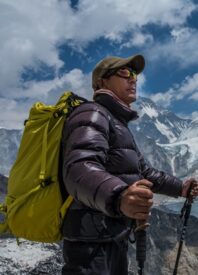
Everest Dark uses a narrator (Jaswant Dev Shrestha), a father or a mentor to mountain guide Mingma Tsiri Sherpa. The narrator recounts taking the young Mingma to climb a glacier, one of the baby steps to Chomo Luma. Chomo Luma, to Westerners, is Mount Everest, sacred to Nepalis and Tibetans but an obsession for mountaineers. Mingma himself is reluctant to return to Chomo Luma because the lives lost to a mountain he considers holy. The deaths reflect the angry deities who feel that too many people are climbing Chomo Luma without giving respect. Despite the angry deities, Mingma reluctantly returns to Chomo Luma to recover the bodies of his fellow lost Sherpa.
There’s a lot of good craftsmanship and good intentions about a film that, with honesty, portrays Mingma’s job. Part of the job includes flying from Kathmandu to somewhere closer to Chomo Luma, and that’s just the beginning. He and his fellow Sherpa also have to recreate a route towards the peak, more difficult because of climate conditions. Sure, some snow seem more stable off season but the Sherpas know which patches are going to melt during the season. The film captures what some may call ‘Indigenous science,’ knowing things about nature from generational knowledge. Everest Dark, to its credit, is respectful enough as it does its best to contextualise its human subjects and their wisdom.
The music in Everest Dark is still violin heavy and slightly Zimmer-y but those cues don’t feel as prominent from what I hear. Credit is also due for this film’s coverage, capturing the Sherpa intimately instead of letting drones to the work. The footage here, evincing quiet observation, hint towards a film that’s better than the one viewers end up with. Yes, this film is better than the creepy POV that others may have towards a mountain full of bodies, climbers and Sherpas alike. But in between moments of the aforementioned quiet observation, the rest of the film feels like it’s over-explaining things.
I feel bad for criticizing Everest Dark because environmental/ nature docs have this adequate mix of beautiful danger. Yes, there’s an intimacy here but it also has its share of medium and long shots of the majestic mountain. It also tries to contextualize where the Sherpas are through maps pointing where they are within the snow filled peaks. Again, a quieter approach, even some interviews, would be more effective in making this an authentic experience for viewers. As the film paces towards its end, one may keep returning to Shrestha’s work as its guiding narrator. I’ll give it the benefit of the doubt that director Jereme Watt told him to narrate with a deliberate pace which is passable even if it’s not for everyone.
Everest Dark is available to watch in select Canadian theatres and goes wide on Mar 2nd across Cineplex Locations.
- Rated: 12
- Genre: Documentary
- Release Date: 2/22/2026
- Directed by: Jereme Watt
- Produced by: Jereme Watt, Merit Jensen Carr, Michael Bodnarchuk
- Studio: Killawatt Productions