
Tibetan Buddhist tradition teaches that great masters reincarnate after their death to continue guiding their followers toward enlightenment. These men “bear the noble title of Rinpoche.” Co-directors Chang-Yong Moon and Jin Jeon’s documentary, Becoming Who I Was, follows a young Rinpoche’s journey. Moon and Jeon have all the ingredients for an easy coming-of-age story but choose to serve up a far more flavourful cinematic dish. Becoming Who I Was makes insightful statements about belief, sacrifice, and human connection. And by the end of the movie, don’t be surprised if Padma’s story sends you on a mad dash for a tissue box.
We meet Padma Angdu when he’s only 9-years-old, an age when many kids’ biggest concerns are eating Happy Meals and playing Minecraft. But this child is a Rinpoche and he leads a life dedicated to preparing him for this special role. Although Padma’s village reveres him, one issue eats away at him. In his previous life, Padma lived in a Tibetan monastery. Even though the Tibetan monastery’s residents have been told Padma is their Rinpoche, they haven’t travelled to Ladakh to bring their him back home. Finally, after no one claims Padma, the Ladakh monastery expels him. It’s here where the film takes a huge turn. Padma’s loving caregiver decides to take him on a 2-month trek across India with hopes of reaching his rightful home.
Kids don’t get any more charming than Padma. He has big bright eyes that take in everything that’s going on around him. He’s also sensitive, an admirable trait in anyone, but especially so for a young Rinpoche. Once he embarks on his journey it’s a blast watching him experience life outside his tiny mountain community. It’s not unlike in Wonder Woman when Steve Trevor introduces Diana to ice cream. During Padma’s first night in the city, he’s baffled when he looks out the window and sees the stars on the side of the mountain instead of in the sky. It was Padma’s first time seeing a sprawling city lit up at night. Even his naivety comes across as almost poetic.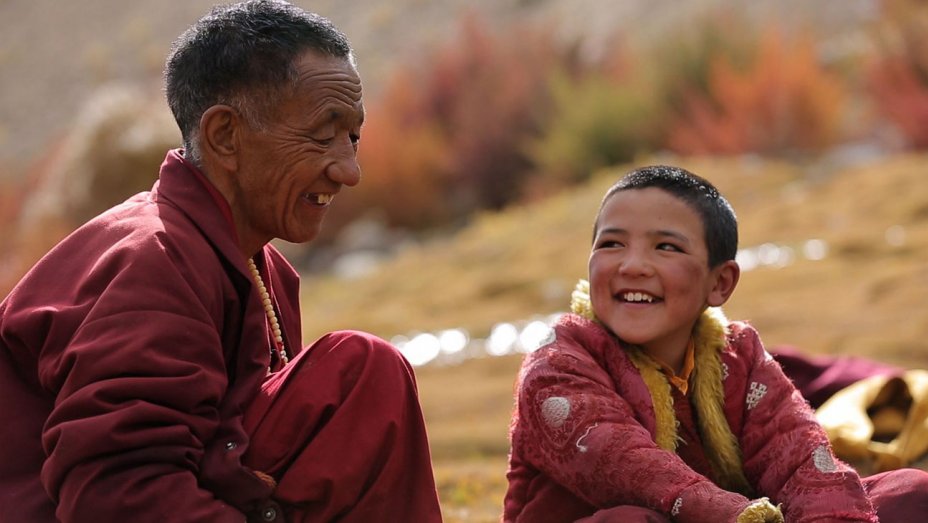
Two sides of Padma surface during the film. Padma is a boisterous kid who easily loses himself in the moment. He’s always laughing and squealing with glee as he plays. And then there is his Rinpoche side, the part forced to listen, study, and be wise beyond his years. Early on, he lectures his mother and sister on the virtues of drinking milk and why they should lay off noodles. It’s not what he’s telling them as much as how he’s saying it; he speaks with a level of authority, and self-assuredness reserved for grownups. He can’t always nimbly navigate between these duelling identities and that’s when it hits you how young he is. Had I found myself in the same position at his age the pressure would crush me.
Becoming Who I Was does a wonderful job of using visuals to tell Padma’s story. Despite the caregivers around him, Padme leads a solitary life. There’s no one who can relate to the path he’s on, the pressure he’s under, and the obstacles he faces. The film often shoots Padma all alone against expansive backdrops to capture his sense of isolation. Seeing Padma beneath an overcast sky with nothing but dirt in the foreground and mountains in the background paints a lonely picture. And as Padma and his godfather trek across India, the journey seems as vast and insurmountable as Lawrence’s journey across the desert in David Lean’s 1962 classic. Much like T.E. Lawrence, the camera makes them look small, inconsequential, and out of place as they travel through unforgiving landscapes.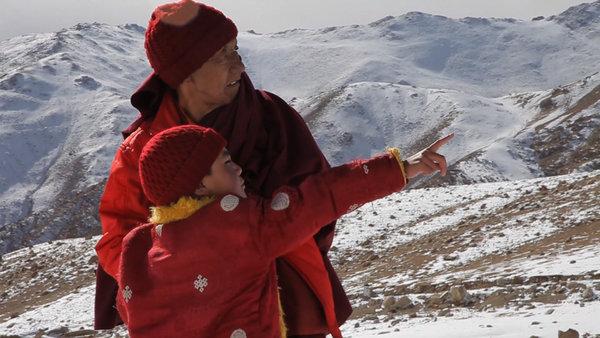
Many of us spend our entire lives searching for meaning, purpose, and connections. As Rinpoche, Padma has already found a life of purpose. It’s fascinating watching how his position gives meaning and purpose to those around him. Padma offers no one a greater sense of purpose than his elderly godfather. He hauls his creaky bones across India with no vehicle and no money because he loves Padma. I’m always inspired by men and women of conviction, but the relationship between these two rises to another level. Becoming Who I Was examines the ebbs and flows of spiritual conviction and offers a heart-warming testament to the strength of human connections.
- Release Date: 6/15/2018