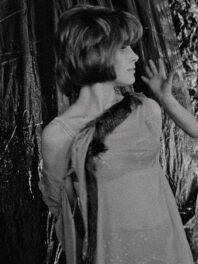
A woman during 2010s Finland, Anu (Tarja Markus), walks over to the desk of her boyfriend, Raimo Lappalainen. Arto Tuominen plays Raimo, a documentary filmmaker and a historian who has a new subject for his new project. That subject is Saara Turonen, (Ritva Vepsä) a nude model from the 1970s who dies from an accident. He occasionally tries to take his mind off of her by participating in Helsinki’s social scene but some things bug him. His subject turns into an obsession when he sees Saara’s contemporary doppelganger, Kisse Havisto (also Vepsä). Kisse replaces Anu as his right hand woman, and of course, their professional relationship turns into a romantic one. That’s already a dicey turn of events, and things get worse when Raimo and Kisse disagree on contemporary politics.
Most directors probably have social issues in mind as they go behind the camera. And that’s true with director Risto Jarva. Coming in with an agenda can sometimes make for a cold film, and it does have that aura during the first half hour. But things get fascinating when we get over that hump, especially since he’s giving us a window of what the future holds. Science fiction, a genre that looks forward, is just as much a doorway of the present time in which that movie exists. Despite having a 2010s setting, the film will obviously show its viewers the free love prevalent two generations prior. The party scene where white twentysomethings lie down and dance with their hands seems like the cuddle parties now. This seems like an innocuous reading of Time of Roses, but its surfaces, as they do, reflect what’s bubbling within.
Time of Roses, as science fiction films normally go, gets a lot of things right and a lot of things that need accuracy. The film captures contemporary historical study now, where historians take people like Sara more seriously now. The film doesn’t confine historical study to major issues, even if it does have that b-plot about a divisive labour strike. Studying a woman, especially not a direct political figure, may have felt revolutionary during a film from the 1960s. Some may be happy about a historian finally focusing on a relatively obscure woman, but there are lacking aspects. Anu and Kisse only exist so that Rimo can have makeout partners, and I feel ambivalent about Rimo switching girls. One can chalk that up to free love, as the film assumes that Western society keeps that philosophy in 2012.
It takes a while for the female characters in Time of Roses to have their say but it is a relief when they finally do. Imagine this as a mod version of Vertigo, and because it uses the future as its setting, there’s more subversiveness. When Raimo finds Kisse, he notices that outside from their looks, she and Saara are each other’s polar opposites. Raimo’s thesis, then, is that one can recreate another person’s circumstances despite having different starting points. This creates a hall of mirrors, where Kisse is watching someone who looks like her and receiving bad treatment. When that effect comes in, viewers may expect a big reaction from someone who, initially, is vacant around the eyes. But that reaction finally comes, making the relationships between characters progressively fascinating to witness.
Time of Roses comes soon on OVID, uncut and commercial free.
- Rated: K-12, TV-MA
- Genre: Science Fiction
- Directed by: Risto Jarva
- Starring: Arto Tuominen, Ritva Vepsä, Tarja Markus
- Produced by: Risto Jarva
- Written by: Jaakko Pakkasvirta, Peter von Bagh, Risto Jarva
- Studio: Filminor