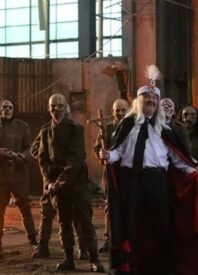
“Dr AI JUDEX 0.0… make a scene with the real Dracula returning to his home”, pleads a washed film Director. Adonis Tanța plays the director with writer’s block, asking AI (triple threat Radu Jude) for supposedly better ideas. In between the reenactments of those prompts, the Director tells the story of three dinner theatre actors. One of them is Adonis (Tanța), whose vocal talents and attitude towards his audience would make him a main character in Drag Race Holland. With Adonis are Uncle Sandu (Gabriel Spahiu) and Vampira (Oana Maria Zaharia) who, as part of their act, hide from their mob-like audience.
And then the prompt results come in, as the Director asks for a reenactment of a Romanian Dracula. In that vignette, Mr. Cociu (Tanța) is a guest at a castle whose shady owner is Baron Wirth (Lukas Miko). In another, the real Vlad Dracula (Alexandru Dabija) comes to 2025 and takes over a startup company. This is not my first time watching a film from Radu Jude, a hit or miss director as sometimes, his ideas aren’t coherent, but I root for him because I just root for ‘national metaphor’ directors. The ideas here are the same in some Romanian and to a certain extent, some German cinema.
That Romanians relegate themselves into exploiting the stereotypes about their country and specifically, a complex, misunderstood figure. In fairness, all people from developed countries find themselves in this trap, and Romanian’s can’t be the exception. Vampires, by the way, are having a resurgence, with Sinners last year and another Dracula earlier this month. So why can’t a Romanian make their own Dracula film like Jude is doing and insert timeless commentary? Composing the big bulk of Dracula are the misadventures of Sandu and Vampira hiding from their mob-like audience. Coming in at close second is a ’50 minute’ adaptation of Vampirul by two Romanian authors back in 1938.
Vampirul has the same archetypes as the Stoker novel, with Cociu as the Harker figure and Wirth as the ‘Dracula’. There’s also Wirth’s niece, Countess Ermina of Kollovrat (Andrada Balea), supposedly an innocent damsel. This vignette in Dracula reminds viewers of German presence in Romania, all of Europe really, before the European Union. Moments in this vignette also have scenes taking place in a sound stage, making this film passably meta. And this vignette also furthers this film’s AI thesis, using it to capture violence instead of confronting it – an interesting choice. Those who reviewed and watched it during its festival and limited release wrote about its AI use.
Thankfully, enough Dracula and its 170 minute running time is purposefully janky to make it feel human. That humanity comes from its actors like Do Not Expect‘s Ilinca Manolache, who stands out even in multiple roles. Outside of depicting violence, it uses AI to depict gratuitous sex and to create budget friendly supernatural characters. My rating for this film is a bit high despite it using AI instead of filming B-roll. This and another festival film sees AI as a way for people under colonization to tell their story. I like this one better for reasons I already listed but also because it’s funnier and more horny. And yes, I almost checked out half an hour before it ends but thankfully that ending has heart.
Film lovers can stream Dracula on MUBI, which-
- Rated: NR
- Genre: Comedy, Drama, Horror, Science Fiction
- Directed by: Radu Jude
- Starring: Adonis Tanța, Alexandru Dabija, Andrada Balea, Gabriel Spahiu, Ilinca Manolache, Lukas Miko, Oana Maria Zaharia
- Produced by: Ada Solomon, Radu Jude, Rodrigo Teixeira
- Written by: Radu Jude
- Studio: Nabis Filmgroup, Saga Film