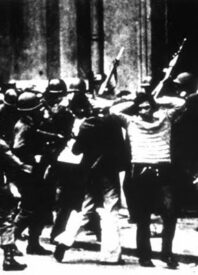
Chilean documentary filmmaker follows up The First Year with The Battle of Chile, all films bleeding into each other. He divides the latter film into three parts, the first showing enthusiasm turning into the real work of maintaining victories. He shows citizens putting up posters warning people of fascism, mourning people like Jose Ahumada Vasquez. The first part, which he entitled The Bourgeois Insurrection, goes hand in hand, obviously with the anthology’s second part. That second part depicts the workers’ small victories against the police, union debates, and the military coup against Allende. The third part, just like the first, shows people taking to the streets to nationalize their industries against imperial oppression. It also interviews workers, both men and women, on their opinion about organizing against the coup and American interests.
Capturing the first three years of the 1970s, the anthology’s first part takes viewers to emotional highs and corresponding lows. Guzman interviews people in the streets, talking to them about who they’re voting for, Allende eventually winning the 1970 election. Bookending the first and the second part is the assassination of an Argentine journalist, showing brazen Chilean military officers. Every part of The Battle of Chile can earn its way into anyone’s list of the best documentaries ever made. But Part II edges the other parts by a few hairs simply because of how contemporaneous and dense it feels. That denseness, obviously, comes from the fact that it’s capturing the shortest amount of time, depicting its leftist meetings. Even if American imperialism looms in the background, Chileans are still making sure that the workers have control and leadership.
Chile, as it appears in The Battle of Chile, is a country of vandalized streets, union halls, and factories full of workers. But even in depicting these spaces, Guzman makes his country look good, a country in several portraits and in pieces. He captured his country in one of its darkest episodes but I can’t help but feel a certain kind of jealousy. And that jealousy stems from the fact that he’s depicting a country with citizens who are politically aware. I can’t help but compare these interviewees against my countries and generation, too apathetic and too tired to have hope. Guzman doesn’t just depict men but women who have that fight in them through their actions and their words. The people on screen stand in contrast against the ‘boomer’ stereotype, reminding us of the sacrifices of that cursed generation.
Patricio Guzman’s films, including The Battle of Chile, are available to stream on OVID.
- Rated: Unrated
- Genre: Documentary, History
- Directed by: Patricio Guzmán
- Produced by: Pablo de la Barra
- Studio: Equipe Tercer Ano