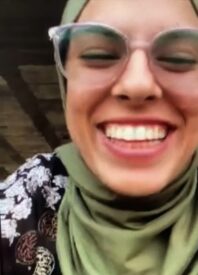
Fatem Hassona is tired, an understandable state of being as a Palestinian undergoing occupation from Americans. She tries to smile through it all and mostly succeeds, or maybe it’s me remembering her first smile. She gave the world that first smile around April 2024, her first video conversation with documentary filmmaker and producer Sepideh Farsi. Farsi’s film Put Your Soul on Your Hand and Walk captures two hours of conversations between the two. These conversations usually take place weekly, although they get more sparse because Hassona has to constantly move.
In between these conversations, Farsi shares Hassona’s sound recordings of bombs and her photographs of Gaza’s bombed streets. It’s easy to lose hope, and hope to Hassona is dangerous, but both cling to a faraway peace. Photographs and video calls comprise Put Your Soul on Your Hand and Walk, a seemingly simple film. That simplicity makes it relatable, and I’ll get back to that, but there are other elements as well. Farsi incorporates news from ‘both sides’ but posits Hassona’s firsthand account as more reliable for the film’s viewers.
Again, Put Your Soul on Your Hand and Walk is just close-ups of both women conversing through Whatsapp. But Gaza is an important subject in this film, which we see through photographs and during the calls. Sometimes, Hassona points her phone camera to the views on her window pixelated because of poor Wifi. There are a lot of images here with varying quality but the film’s depiction of Gaza’s rubble is undeniable. It’s a strip of land with people who want to live simple lives, as Hassona says, something Europeans deny her.
Sometimes, Farsi shows her cats and her life as a travelling filmmaker in contrast again to Hassona. It’s easy to feel guilty about these contrasts and Farsi is aware of all of that. The conversations between them are key here still, as they don’t always talk about the genocide against Palestinians. Hassona gets the idea that hope is dangerous from The Shawshank Redemption, reminding us of her normal dreams. Fatem Hassona is just one of hundreds of thousands who died because of colonization that needs to stop.
Farsi, in depicting Hassona, a regular, normal young woman from Gaza, but this feels like a diptych. This is actually a good thing because she at least knows which human subject belongs on the forefront. That subject is Hassona, a young woman who can maybe save herself and get out of the Gaza Strip. “I think Gaza needs me at this time,” she says, a strip that needs young, brave photojournalists. People like her, who are of the land, should have the choice to stay and have fruitful lives.
- Rated: 15
- Genre: Documentary, War
- Release Date: 11/7/2025
- Directed by: Sepideh Farsi
- Produced by: Annie Ohayon-Dekel, Sepideh Farsi
- Studio: 24images, Rêves d'Eau productions